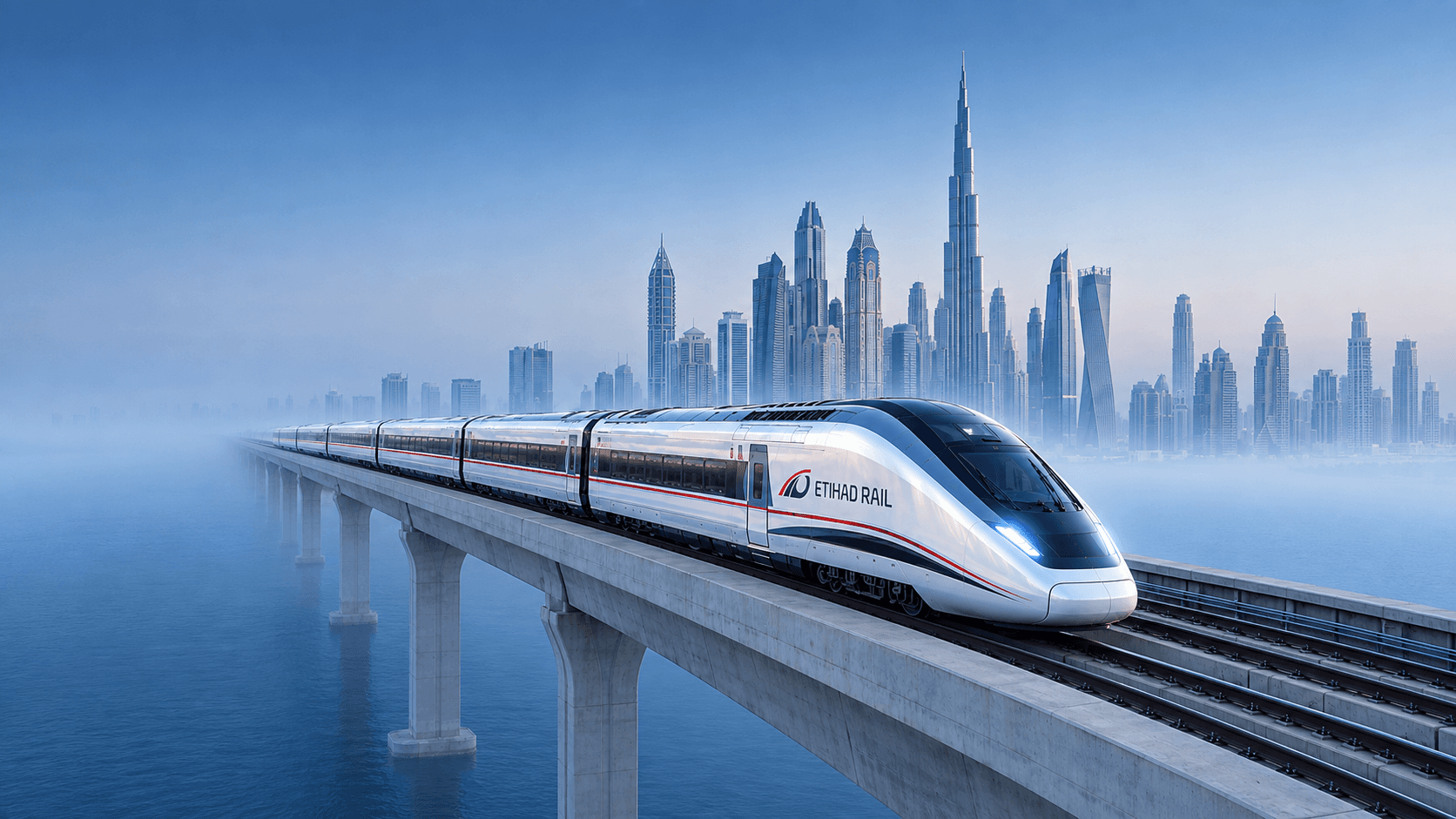
Etihad Rail and the Future of UAE Real Estate - How Passenger Connectivity Is Reshaping Property Demand and Community Growth
Blog
Published: October 03, 2026Share this
The UAE has long been known for building infrastructure that does more than connect places — it creates new opportunities for people, businesses and communities.
The launch of Etihad Rail passenger services marks another important step in the country's growth. As the UAE's national passenger railway expands across the country, connectivity is becoming an increasingly important consideration not only for how people travel, but also for where they choose to live, work and invest.
For the UAE real estate market, this creates an interesting new dynamic. Property's appeal has traditionally been shaped by factors such as location, amenities, schools, employment centres and lifestyle. Increasingly, accessibility is becoming part of that equation. When a new transport connection makes it easier to reach employment, business, leisure and family destinations, areas along the network can become more accessible to a wider population.
Etihad Rail could therefore play a role in changing how proximity is understood across the UAE property market.
From Transport Network to Real Estate Opportunity
Etihad Rail's passenger network is being introduced in phases. Passenger services began between Abu Dhabi and Fujairah in June 2026, while Dubai and Al Dhaid joined the network on 30 September 2026. Further stations are planned in the Al Dhafra region, followed by Sharjah in March 2027. Once the passenger network is complete, it is expected to connect 11 cities and regions across the UAE.
This matters for UAE real estate because transport infrastructure can change the practical meaning of distance.
A location that once required a long drive may become considerably more convenient when a reliable rail connection is available. For residents, that can mean more choice in where they live. For developers, it can open opportunities to consider locations beyond traditional high-demand areas. And for investors, transport connectivity can become another factor to assess when evaluating the long-term potential of a property or community.
International research supports the broader relationship between transport accessibility and property markets. The OECD notes that public transport infrastructure can have positive effects on property values, while World Bank research has found that new rail infrastructure can create land-value premiums where it produces meaningful accessibility improvements. Importantly, the impact varies according to local conditions, surrounding development and the quality of the connection.
For the UAE, the potential significance lies in the scale of the national network and the number of communities it is designed to connect.
1. Flexibility: Expanding Where People Can Live
One of the most immediate benefits of passenger rail is greater flexibility.
For many residents, the decision about where to live involves balancing several competing factors: proximity to work, housing costs, lifestyle preferences, family commitments and access to amenities.
Better inter-emirate connectivity can potentially widen those choices.
Etihad Rail itself describes passenger rail as a service designed around everyday mobility — including work, family and leisure — with predictable journeys and connections between cities and regions.
This introduces a different way of thinking about residential property location.
The question may gradually shift from “How close is my home to my workplace?” to “How connected is my home to the places that matter to me?”
That is a meaningful distinction for the UAE property market.
2. Connectivity Can Influence Property Demand
When accessibility improves, the potential pool of people who can realistically consider a particular location may also expand.
For example, a community connected to the rail network could appeal to residents who value access to employment centres without necessarily wanting to live immediately beside them.
The same principle can apply to rental properties. Tenants may increasingly consider transport accessibility alongside rent, size, amenities and building quality. A property that provides convenient access to a rail station could potentially offer an additional lifestyle benefit — particularly for residents whose work, education or family commitments span different emirates.
This does not mean every property near a station will automatically increase in value. Real estate performance depends on numerous factors, including supply and demand, location, development quality, pricing, surrounding amenities and broader economic conditions.
However, transport accessibility can become an additional differentiator.
Research from the OECD and World Bank similarly highlights that the relationship between transport and property values depends on the accessibility gains created by the infrastructure and the characteristics of the surrounding area.
For developers and buyers, that makes connectivity an increasingly relevant part of the location story.
3. Investment Potential
Real estate investment is inherently forward-looking. Investors do not only consider what a location offers today; they also consider how the surrounding area could evolve over the coming years.
This is where major infrastructure projects can become particularly significant. A new rail station can change accessibility, but its wider impact may extend into the surrounding community. Increased accessibility can support new residential development, retail, hospitality, offices and community services where planning, land availability and market demand support such growth.
The World Bank's transit-oriented development research highlights three important dimensions when assessing areas around transport stations - the importance of the station within the transport network, the quality of the surrounding place, and the area's market potential.
4. Rail Can Help Communities Grow Around Connectivity
The impact of Etihad Rail may ultimately extend beyond individual properties.
Transport infrastructure can act as a catalyst for community development.
As accessibility improves, businesses may have greater reason to locate in emerging areas. New residents can create demand for retail, restaurants, schools, healthcare, hospitality and other services. Developers may then have stronger incentives to create mixed-use communities designed around the needs of a growing population.
This is the broader concept behind transit-oriented development - integrating transport with housing, employment, services and public spaces so that communities become more connected and accessible.
5. A Wider Talent and Employment Catchment
Connectivity also has implications for the commercial property market.
Businesses are influenced by access to customers, suppliers, employees and other businesses. A more connected transport network can potentially expand the geographical area from which companies can attract employees.
For an employer, this could mean access to a broader labour pool and for an employee, it could mean more employment opportunities without necessarily requiring a move closer to the workplace.
Looking Ahead
The real question is what happens next.
As more people begin using Etihad Rail as part of their everyday lives, patterns of movement across the UAE may gradually change. Areas that were once considered distant from major employment and business centres could become more practical for residents, businesses and developers.
Etihad Rail is still at an early stage of its passenger journey, so its long-term influence on property demand and development will take time to become clear. What is already changing, however, is the way connectivity can be considered when thinking about location.
The next generation of real estate development may not be defined only by what a community offers within its boundaries, but also by how easily it connects people to opportunities beyond them.
Other Blogs


GET IN TOUCH
Have Questions?
We're Here to Help
We're ready to answer your questions. Let our RERA-certified experts guide you every step of the way from shortlisting to handover.
Free Consultation
No hidden fees – expert guidance only
100+ Awards Won
Dubai's most awarded real estate agency
RERA Certified
All agents fully licensed and certified
30-Minute Response
During business hours, guaranteed
Request Free Consultation
Fill in your details - we'll respond within 30 minutes
Copyright © 2026 H&S Real Estate, All Rights Reserved